Author: Admin

How to Choose the Right Software Development Model for Your Business

When you begin building a digital product, be it anything a web app, mobile app, SaaS platform, or internal tool, the first decision you’ll make is how the software will be developed. Many tech heads often miss this part, and they rather jump right into coding without deciding the approach that supports their timeline, budget, and growth plans. That’s where choosing the right development model comes into play.  

Think of software development model as the roadmap for your software journey. A bad choice here? It can lead to wasted time, re-work, and expenses no business likes dealing with. On the flip side, selecting the right approach becomes a competitive advantage, because your product reaches the market faster, performs better, and scales when your business scales. 

As we at Software Experts India actively publish real-world technology insights backed by industry experience, this guide is designed to help you understand what really matters.  

 Let’s look at the most crucial part of this decision:

Understanding Software Development and Its Models  

Before we move ahead in choosing the right fit, it is important to know what it is. As the name suggests, it is the process during which an entire software is developed and brought into existence. In the easiest terms, software development is the process of planning, designing, developing, testing, and managing applications. 

Moving on to the types of software development models, here is a quick at a glance view for the better understanding ahead.

Development Model  Best Suited For  Key Benefits  Main Drawbacks 
Waterfall  Projects with clearly defined requirements and fixed scope  Predictable structure, strong documentation  Very rigid, difficult to handle late changes 
Agile  Projects with evolving needs and faster delivery needs  High flexibility, continuous feedback, quicker releases  Harder to estimate cost + timeline, requires constant stakeholder involvement 
Scrum  Teams needing frequent changes and close collaboration  Short sprints, transparency, adaptability  Highly dependent on team skill and discipline 
Kanban  Continuous workflows with shifting priorities  Clear visual workflow, easy adaptability  Can lack structure for large or complex projects 
DevOps  Projects requiring frequent updates and fast deployments  Faster delivery, strong collaboration, reliable releases  Needs cultural transformation and skilled teams 
Lean  Cost-efficient innovation with value-focused delivery  Reduced waste, faster validated output  Risk of oversimplifying features 
Hybrid  Projects needing both structure and flexibility  Best parts of multiple models, fully customizable  Complex to manage and requires strong coordination 

Things to Consider in Choosing a Development Model

Not every business has the same goals. Some software development company look forward to quick delivery while others may have different goals. Which makes it important for your development model to align with the end vision. Here’s what you must evaluate, in detail:

Clarity of Requirements and Project Vision  

Before choosing any model, take a moment and ask yourself: 

  • Do we have a clearly defined product from day one? 
  • Are the features fixed or likely to evolve based on user feedback? 
  • Is the problem well understood, or are we still exploring solutions?

If your requirements are crystal clear, like building a system with strict standards, banking software or a government portal, a model like Waterfall or V-Model ensures structured progress with strong documentation. 

But if your project is evolving, like most startups and modern digital products, the ability to adapt is crucial. In that case, Agile development gives you the flexibility to build, validate, and improve continuously. 

Here’s a quick comparison to help you assess your clarity level:

Requirement Situation  Best-Suited Models  Why It Works 
Fixed scope, defined workflows, strict compliance  Waterfall, V-Model  Predictable planning and strong documentation 
Evolving ideas, market-driven changes  Agile, Scrum, Kanban  Faster iterations and value delivery 
Uncertain goals, research-heavy products  Spiral or Lean  Focus on experimentation and risk reduction 

Take this from us that if you’re still writing down features and trying to understand user expectations, choose a model that allows discovery, not one that forces decisions too early.

Timeline, Budget, and Resource Flexibility 

Every business care about time and money and rightly so. The development model you pick determines how predictable or flexible these factors will be. 

A few honest questions to consider: 

  • Do we need to launch fast to capture the market? 
  • Is there room in the budget for iterations or changes? 
  • Do we have in-house technical expertise or a small external team? 

Some models offer predictable costs and schedules that are helpful for companies with strict budgeting. Others allow experimentation but with variability in timeline and expense. A clear breakdown:

Business Priority  Recommended Approach  Benefit 
Fixed budget & fixed deadlines  Waterfall / Fixed-Price Agile  Cost control with structured delivery 
Goal is fast launch with continuous updates  Agile Scrum  Early market entry + ongoing improvements 
Higher focus on prototyping & innovation  Spiral / Lean  Minimize risk, validate fast 

Realistically, most modern companies want results without burning cash. Agile-based models let you deliver core features early, test adoption, and avoid over-investing in features nobody needs. 

Brands that rank high in digital innovation today rely on iterative development because it eliminates assumptions and focuses on spending on what users truly value.

Product Type, Tech Complexity, and Long-Term Maintenance

This is where many teams underestimate the future. Launching software is not the finish line and it’s the starting point. The development model impacts: 

  • How smoothly updates, security fixes, and scaling happen 
  • Whether the architecture supports future business growth
Product Nature  Complexity Level  Suggested Models 
MVP, early-stage startup product  Medium  Agile / Lean 
Enterprise-grade system with integrations & compliance  High  Waterfall Hybrid / DevOps 
Tech-first product requiring constant improvement  Very High  Agile DevOps Combination 

If your product requires: 

  • High security (FinTech, HealthTech) 
  • Multiple system integrations 
  • Detailed testing cycle 

then your model must support robust architecture planning and quality assurance from day one. 

Meanwhile, customer-facing digital platforms like eCommerce or SaaS thrive on continuous enhancement, which is Agile + DevOps lets you ship updates weekly or even daily.

Choosing the wrong model here could trap your business later, making scaling expensive, slow, and risky.

Putting It All Together for Final Decision

Here’s a quick framework decision-makers use: 

  • If your requirements are 100% clear → Choose structured models 
  • If your vision is evolving → Choose adaptive, iterative models 
  • If early launch matters → Prioritize Agile-based approaches 
  • If your product will grow for years → Pick a model that supports scalability + DevOps 

And don’t forget: the best choice is often a hybrid model aligned to your product life cycle. Always choose to hire software developers who mix Agile for new features and Waterfall for compliance-driven modules. The smartest decision is the one that aligns with your users, your market timing, and your business readiness.

Importance of Choosing the Right Software Development Model

Selecting the model that aligns with your goal and partnering with the right software development company determines the performance of your project to a great extent. Your team dynamics, the ability to change the project scope, the preservation of the project’s budget, and, as a result, the quality of the product are inextricably linked to this model.

Here’s why it matters:  

  • Time Efficiency: Some of the models, for instance, Agile, are based on flexibility and speed, and this may take a lot of time and, hence, may lead to a lot of time being spent, which is the case when using the waterfall model. 
  • Budget Control: It is also important for different models to manage resources in different manners. With Agile, you can implement it in stages, and this comes in handy when it comes to costs. Should some changes occur in mid-development, then with a model such as Waterfall, this could be very costly.
  • Flexibility: Agile and Scrum facilitate flexibility, which is crucial if the development of project requirements changes in the middle of the project life cycle. However, the waterfall model does not afford flexibility since change in any of the stages brings significant complications.  

Making the wrong selection can cause serious problems, including a slowdown in project delivery, increased costs, and failure to achieve the set project objectives.

Common Mistakes to Avoid While Selecting Development Model 

Even experienced businesses slip here, but you don’t have to. Here are some common mistakes that you need to avoid while looking for the software development model that actually aligns with your goals.

Mistake 1: Choosing What Others Are Using

Just because a famous company uses Agile doesn’t mean it’s perfect for you. Your business goals come before the ongoing trends. 

Remember the simple math here is 

  • Right model = higher success rate.  
  • Wrong model = expensive restart.

Mistake 2: Underestimating the Role of Users

Some businesses build a software for months before users touch the product and then discover it’s not what people want. 

If user wisdom is key to your success, you need prototyping or iterative feedback loops built into the process. 

Mistake 3: Ignoring Documentation

In a rush to build faster, teams often skip documentation, and then they actually need it. If you plan to scale later, documentation isn’t optional majorly for integration-heavy systems.

 Mistake 4: Not Asking “What If Something Goes Wrong?”

Risk management isn’t scary, but ignorance is. If failing late means failing big, choose a model that identifies risks early. 

A simple checklist can prevent a disaster: 

Risk Control  Suggested Approach 
Very High  Spiral, V-Model 
Moderate  Incremental 
Low  Agile / Waterfall (depending on clarity) 

Conclusion  

Choosing your software development model is not just a technical decision rather it’s a strategic business call. Take your time to map your goals, uncertainties, team capacity, and long-term vision. The right selection today ensures your product stays relevant tomorrow. 

And here’s the comforting part: you don’t need to know every technical detail. You just need clarity in what you want your business to achieve. A dependable tech partner translates that into the model that delivers the best results.

Frequently Asked Questions  

1. What is the right software development model for projects with dynamic needs?

Agile or Iterative models are useful, as they facilitate constant changes, fast feedback, and plan modification, when requirements are changing or ambiguous.

2. Is it possible that choosing the wrong development model will cause project costs?

Yes. Incorrect model selection can cause time wastage, re-work, scope creep, bad documentation or late identification of bugs- all which means more money. 

3. Is Agile appropriate for small teams, or Waterfall?

Agile can be carried out by small teams in case they are highly collaborative and experienced. But then again, when the team is not structured, disciplined or quick feedback cycle, then a more linear approach such as Waterfall or Hybrid model might be appropriate. 

4. Which development model would be the most optimal when I have a fixed budget?

Waterfall or Hybrid is better since upfront planning assists in controlling the cost. Agile can push the budget when it is not managed well. 
The Influence of AI and ML on Modern Enterprise Applications

Business and its competition- a never-ending story. But it is essential. Otherwise, how can you stay ahead and become the best. Don’t you think the same? Take the example of any successful business, and you will find that they have constantly adapted over time. They have made good decisions at the right time.  

Using AI and ML in your business can be a good decision for the future. You can take our enterprise app development services for the same. Read this blog to know the role of AI and ML in modern enterprise apps. Why to discuss this thing can come to your mind? Because these technologies are changing the operations of enterprises. Big businesses are already using AI and ML. And as result they are becoming more efficient. 

What is AI and ML? 

You may have a deep understanding of these technologies. It is also possible that many others may not. Let’s start with the introduction to AI and ML. 

AI is the capacity of a machine to replicate intelligent human behavior. It can perform tasks that humans can take hours to complete. Such as data analysis, patterns recognition, and decision making.  

Machine Learning on the other hand is a subset of AI. In ML we train algorithms to learn from data. ML also has the ability to improve over time without human intervention.  

Now think what these two can do to your business? If you need such software solutions, you can contact our enterprise app development company.  

What is the Role of AI and ML in Modern Enterprise Apps? 

AI and ML come with many benefits. Here are the changes it can bring in modern enterprise applications.  

Improve Decision-Making 

AI and ML can improve decision-making. How? You can think of an enterprise app that analyzes a large amount of data in real time. AI analytics is the tool we are talking about here. Businesses can identify trends and insights that human analysts might miss. Businesses can use this data to design smarter strategies and better outcomes. 

Let us give you an example of a retail company. It can use AI to analyze customer purchasing patterns. It can predict what products will be in demand and adjust their inventory accordingly. This not only reduces waste but also improves customer satisfaction. You can also improve the decision-making of your organization by using our enterprise app development services

Automating Routine Tasks 

The main idea of AI and ML is to automate routine tasks. It is developed to help humans in repetitive work. But how far it will go is another question mark on its journey. Well, let’s come to the topic again.  

With AI/ML services you do not have to do data entry manually. You can also use it to resolve customer inquiries. Need an example? Chatbots. They can answer common questions and even troubleshoot issues. Are you also fed up with this kind of repetitive work? Reach out to our enterprise app development company for solutions.  

Supporting Human Resources 

The human resources process of recruitment and employee management can be frustrating sometimes. But not when you use AI and ML. These technologies can streamline these processes. AI/ML can be used to analyze resumes and assess candidate fit. 

Imagine an enterprise app that can screen hundreds of applications in minutes. AI can identify the best candidates based on specific criteria. It will save HR teams time and effort. Consider our enterprise app development services to scale your business.  

Optimizing Predictive Maintenance 

The functioning of some businesses depends on machinery. Especially those who are in the manufacturing sector. These businesses can get the benefits of predictive maintenance.  

Also Read : Why Custom Software Development Matters for Robust Industry

Predictive maintenance is the ability to predict failures before they occur. This can be done by AI and ML. Because they can monitor equipment performance that too better than humans. This approach reduces repair costs. Sensors are its biggest example. They can collect data on machine performance. And AI can analyze this data to estimate when maintenance is needed.  

Better Security 

Cyber threats in this digital age are like a pandemic to any enterprise. Security is a top priority for enterprises. AI and ML can also help you with that. How? Because they can analyze patterns in data to detect unusual activities and potential threats. 

You can take an example of a fraud detection enterprise app that uses AI algorithms to monitor transactions. They can identify anomalies in real time and alert businesses to potential fraud before it escalates. If you are also looking for enterprise app development services to strengthen your security, we are happy to help.  

Best User Experience 

It is important to understand user preferences and behavior. Why so? Because it helps to recommend them products and content that meet their interests. This personalized experience is possible with the help of AI and ML technologies. 

Let’s take an example. Open streaming platforms like Netflix or YouTube. What type of content do you find the most? The one you are interested in. Right? This is possible because these platforms use AI algorithms to suggest shows based on your viewing history. 

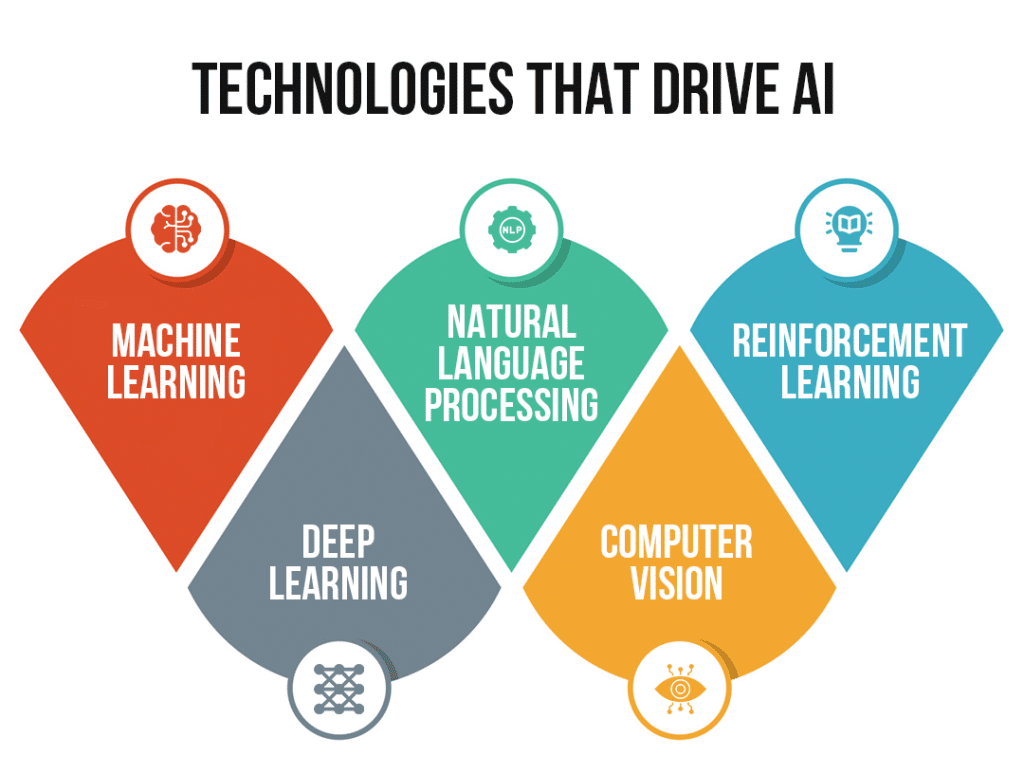
What are the Tools and Technologies That Drive AI? 

AI is further divided into different fields. AI powered tools are flooding the market. We have provided some of the popular AI technologies with the names of some useful tools. 

Technologies that drive AI - Infographic
Technologies that drive AI

Machine Learning: We have already provided its introduction at the beginning of the article. ML enables computers to learn from data. Popular ML tools are  

  • TensorFlow 
  • Scikit-learn 

Deep Learning: It is a subset of ML. It uses neural networks with many layers. Its tools are: 

  • Keras 
  • Caffe 
  • MXNet 

Natural Language Processing: NLP helps machines understand and generate human language. Tools include: 

  • spaCy 
  • NLTK 
  • PyTorch 
  • Transformers by Hugging Face 

Computer Vision: This is the field of AI that allows machines to interpret and process visual data. Tools are: 

  • OpenCV 
  • YOLO (You Only Look Once) 
  • Fastai 

Reinforcement Learning: The process of training models to make decisions through trial and error is called reinforcement learning. Tools are: 

  • OpenAI Gym 
  • Stable Baselines 
  • RLlib 

Conclusion 

AI and ML tools are important for businesses success. And because you have gone through this blog, we assume you know why? 

If you have not integrated these tools into your business, we recommend you do so. Because this can improve efficiency and help you to stay competitive. You can use our enterprise app development services to take your businesses to new heights.  

FAQs 

How can AI and ML improve my business operations?  

You can use AI and ML service to automate things that you are doing manually. If you are fed up with analyzing the data over and over again or doing routine tasks repetitively- use our enterprise app development. We will use these technologies to help your business grow. 

What types of tasks can be automated using AI and ML?  

AI and ML can automate repetitive tasks. It can perform data entry operations and handle customer inquiries through chatbots. It will help your team to focus on more strategic work. Ready to reduce your workload? Our enterprise app development company can help you implement these solutions. 

What security benefits do AI and ML offer?  

AI and ML can enhance security by analyzing data patterns to detect unusual activities and potential threats. This proactive approach helps prevent cyber fraud. Looking to strengthen your enterprise security? Reach out to our enterprise app development company. 

How can AI help enterprises? 

AI will help you in making more informed decisions. It also eliminates the need of a human for repetitive tasks. Personalized user experience and predictive maintenance are some other benefits AI brings to the table.  

Why Custom Software Development Matters for Robust Industry

“GOAL” is one of the important achieving for every business no matter what business you run, right? In today’s technological business trend, every organization wants to make their industry robust, flexible and agile for targeting their goal of success. In simple words we can say, having robust tools and solutions to fulfill client satisfaction, processes, and integrate the growth in your custom software development initiative. 


This is where the aspect of custom software development falls into the picture. Throughout this blog you will walk through A-Z about benefits of custom development to unlock your business by integrating a customized solution. Without any delay, let’s get going. 

Current Market Trends in Custom Software Development 

A custom programming improvement organization assumes a pivotal part in assisting organizations with flourishing by planning programming that fits impeccably with their tasks.

Goal of Market Analysis – 

  • The interest for custom programming improvement is developing quickly. Organizations across enterprises are looking for arrangements that offer greater adaptability and versatility contrasted with nonexclusive programming. This is particularly valid for organizations with complex cycles or explicit prerequisites that can’t be tended to with one-size-fits-all arrangements. 


  • Statistical surveying shows that organizations will put resources into custom programming since it gives them an upper hand. By having programming that is intended for their extraordinary activities, organizations can smooth out processes, further develop efficiency, and improve client encounters. Additionally, the ascent of distributed computing, computer-based intelligence, and AI has opened up new open doors for custom programming, making it more appealing to organizations hoping to improve. 


  • Ideal target group, Custom programming improvement is great for medium to enormous organizations that have grown out of standard programming arrangements. These organizations are searching for ways of further developing effectiveness, decrease expenses, and remain in front of the opposition. Organizations in areas like money, medical services, retail, and assembling frequently go to a product improvement organization to fabricate custom applications that take care of their particular necessities. 


  • New companies and developing organizations likewise structure a critical piece of the ideal group. They need programming that can scale with their business and adjust as their necessities advance. For these organizations, putting resources into custom programming right off the bat can set aside time and cash over the long haul, as it forestalls the requirement for steady changes and workarounds that are frequently expected with off-the-rack arrangements. 


Advantages of Custom Software Development  


  • Customized Arrangements: Custom programming is intended to fit the specific necessities of your business, guaranteeing that it lines up with your cycles and objectives. 


  • Versatility: As your business develops, your product can develop with it. Custom arrangements are worked to be adaptable and versatile, making it simpler to add new highlights or handle expanded jobs. 


  • Upper hand: With a one-of-a-kind arrangement customized to your business, you can separate yourself from contenders who depend on conventional programming. 


  • Further developed Proficiency: Custom programming can computerize and smooth out processes, diminishing the requirement for manual work and limiting blunders. 


  • Practical over the long haul: While the underlying speculation might be higher, custom programming can set aside cash over the long haul by disposing of the requirement for steady updates or extra acquisition of off-the-rack items.  


For what reason Do Organizations Require a Custom Software Solution? 


Since you have lucidity and a superior comprehension of what custom programming improvement has allowed us to walk you through why organizations in the 21st century require a modified programming answer for the development of their business. 


Clients’ prerequisites drive firms; in this way, that is one of the principal justifications for why it’s fundamental at the present time. Also, a few different signs will demonstrate that your business needs custom programming. The explanation is that such programming is essential for meeting their business needs contrasted with what instant programming gives. Allow us to take a gander at a couple of reasons organizations pick custom programming for their definitive achievement. 


 Steps – 


  • To satisfy corporate prerequisites and smooth out organization methods. 


  • To furnish a simple application joining with the generally existing frameworks. 


  • To make the application quick and responsive. 


  • To have an upper hand in contrast with the companions. 


  • To meet the most significant levels of protection and security. 


Once more, there is a never-ending battle inside associations as they balance building and buying. We have ordered a rundown of benefits that picking programming improvement can assist you with opening to lighten your comparative test. 


Conclusion


A custom programming improvement organization can change how your business works by giving an answer that suits perfectly. In an undeniably serious market, organizations should be coordinated, productive, and client centered. Custom programming advancement offers the adaptability and ability to accomplish those objectives, making it a fundamental venture for organizations hoping to develop and succeed. 

Is the Software Development Cycle Still Relevant in 2024?

In today’s evolving tech space, new frameworks, methodologies and tools are available for software development purposes. This leads to an important question, about the relevance of the Software Development Life Cycle (SDLC) in 2024. For building quality and feature-rich applications, SDLC process model has served a key constituent.

However with the increasing emphasis on agility and speed in the era one wonders if the traditional SDLC approach remains the effective method. This blog delves into exploring the significance of SDLC, its evolution over time and whether it still holds a role in software development practices.

Overview of Software Development Cycle

Software developers employ a process to design and develop professional applications using a set of steps involved in the Software Development Life Cycle (SDLC). The core objective of SDLC approach is to build an application that meets or surpasses end-user needs in an engaging and secure manner. It helps developer to complete software development within the defined timelines and budget constraints.

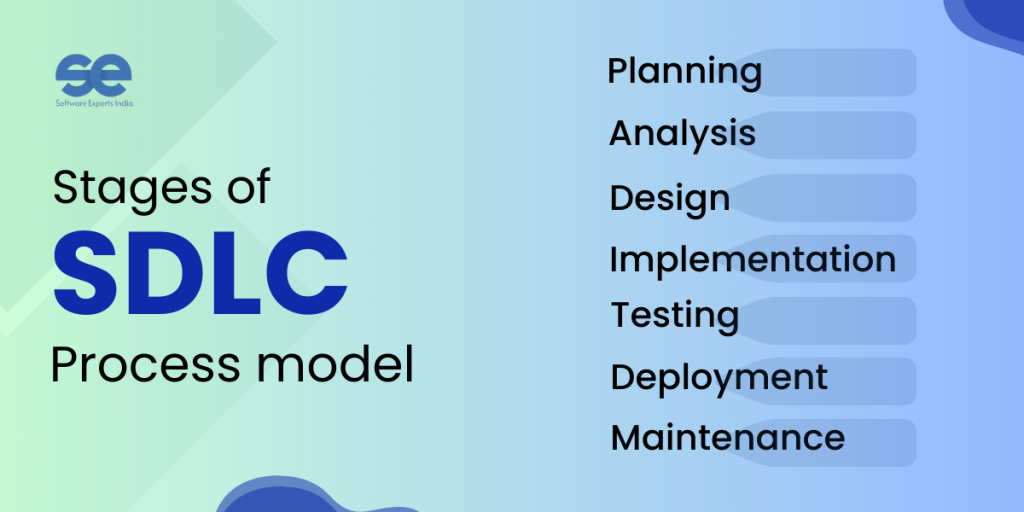
Stages of SDLC Process Model

Stages of SDLC Process Model
  • Planning- Defining project scope and objectives.
  • Analysis- Collecting and scrutinizing requirements to grasp what needs to be achieved by the software.
  • Design- Structuring the software to fulfill specified requirements.
  • Implementation- Coding to bring developed software.
  • Testing- Making sure the software works properly.
  • Deployment- Getting the software out to users.
  • Maintenance- Keeping the software up, to date and maintained.

The importance of SDLC is in its capacity to offer an approach, for creating software in a managed and systematic manner making sure each stage is finished before progressing to the next.

Also Read : Benefits of Using Custom Software Development Solutions for Your Enterprise

Evolution of Software Development Life Cycle

The SDLC approach has been through a number of changes over the years. It should be noted that in the beginning of the usage of the SDLC, the Waterfall model was the primary process model that was utilized. Being a linear and sequential design process, the phases had to be accomplished one after the other. But this model was frequently labeled as ‘phased’ and incapable of improvement after a phase was over.

With increase in complexity in software projects other methodologies surfaced. The V-Model was an extension of the Waterfall model and was first to use validation and verification at each stage of development. However, the process was still more linear and this might not be convenient during rapid operations. This was the major difference between the V-model vs Waterfall model for developers to make a smart selection.

There were some constraints that were posed, and to counter them, Agile and DevOps paradigms had been developed, where frequent delivery, integration, and adaptability were the priority. These approaches made it possible for teams to respond to alterations in a better and more effective manner with the delivery of the software.

For this reason, many structures integrated these new approaches with the SDLC approach to come up with models that incorporated the SDLC advantages while at the same time embracing the precise rapidity needed in current software development.

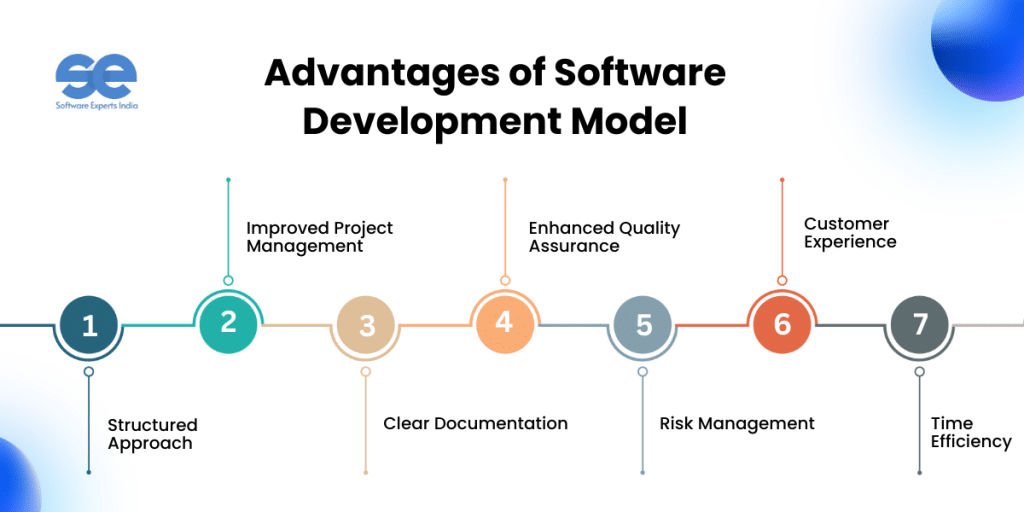
Advantages of Software Development Model

Advantages of Software Development Model

1. Structured Approach

The SDLC process model is a clear, sequential approach that will guarantee that the development of software is standard. The structure also allows the teams’ work to be more integrated, and the probability of omitting some of the steps in the process is significantly lower; therefore, the outcomes could be better managed.

2. Improved Project Management

Larger with clear stages and defined milestones, SDLC approach is easier to manage as it allows for easier project management. The plans are helpful for project managers for tracking the rate of progress, the distribution of resources, and for keeping things on course with regard to time-line and cost.

3. Clear Documentation

Clear documentation is created in each phase of the SDLC. This helps as a future maintenance and upgrades reference point. This documentation assist different team members to build code quickly and ensures that the software maintenance process is performed properly.

Also Read : 8 Key Benefits of Software Development Consulting Services

4. Enhanced Quality Assurance

The SDLC process model includes multiple phases dedicated to testing and validation, such as the V-Model where verification and validation occur at each stage. This focus on quality helps identify and resolve issues early, reducing the likelihood of defects in the final product.

5. Risk Management

Risks are always on the cards when you plan to build a software application. The SDLC approach allows for early identification and mitigation of risks. With SDLC

developer can break down the project into smaller, easy to manage phases, to identify problems and address them before they escalate into bigger problems.

6. Customer Experience

The reason behind SDLC success is to build an application that meets or exceeds user expectations with personalized application development. By following a structured approach with regular reviews and feedback loops, the SDLC ensures that the final product aligns with customer requirements, leading to higher satisfaction.

7. Cost and Time Efficiency

While the Waterfall model and traditional SDLC models can seem time-consuming, their structured nature often leads to fewer revisions and rework, ultimately saving time and costs. This is especially true in projects where requirements are well-understood and unlikely to change.

Current Relevance of SDLC Model in 2024

As we look at 2024, SDLC is still applicable but not in the fundamental form as was initially introduced. Several business groups still knows the need of SDLC especially in those that are governed by regulations, safety and reliability for instance healthcare, finance and aerospace.

Business Use Cases of SDLC

For instance, an organization in the healthcare sector could us the classical V-Model when developing software that is required to meet certain regulatory requirements while adopting Agile methods during the transition phase because of the dynamism of the users’ needs. Likewise, a financial institution may apply also a variant of Waterfall labeled as ‘Protected Waterfall’ for the core banking applications, in order to keep them secure and reliable, whilst adopting DevOps for applications exposed to the customers.

Future of the Software Development Cycle

The Software Development Life Cycle will continue to evolve in the future as well to meet the demands of modern software development.

Predictions: The chances are very high that in the near future, hybrid strategy where both traditional and SDLC and Agile and DevOps structured models work in sync. Such models could then provide more of both, the ‘orderly progression of steps’ of a defined process, but also the ‘loose heuristic’ required in the form of rapid innovative development.

Potential Innovations: Integrated application development tools, CI/CD pipelines, and Test Automation tools will probably have a great influence on the SDLC process model in the future.

Sustainability: Whether the SDLC approach stays put as the fundamental model or is supplanted by progressively versatile applied models will depend upon the general flexibility of companies.

Concluding Thoughts

From the period it was introduced in the software development process, the Software Development Life Cycle has been through various transformations in terms of methods, equipment, and technology. The general significance of SDLC is evident—it is the basis for effective software development and software maintenance—that still leaves its further evolution to the changes of the world pace.

By 2024 and beyond it is unlikely to be as trends-leading as it was prior to the mid 2000s but will continue to have significance in those industries that value formality, stability, and paper trails. In this way, its sustainability is in its retention of flexibility to accommodate the newer practices in it.


8 Key Benefits of Software Development Consulting

Most software development projects don’t fail because of bad coding. They fail because of weak direction. That is why companies tend to run into pitfalls: the project becomes delayed, the technology is chosen inappropriately, and it overspends. 

Although the majority consult AI or the internet to find the answers, they are not always accurate. It could be harmful to experiment with these solutions, particularly if the software is enterprise-level. 

The good news? There are software experts who can help. With their guidance, you’ll identify risks early. That’s one of the benefits of software development consulting. 

This article won’t cover just the basics. We’ll be deep-diving into the benefits and how it will benefit your business.

Overview of Software Development Consulting

Software consulting is about offering expert guidance or support for software development. The process involves developing a strategy, evaluating performance, and offering support for your software.  

Businesses that don’t ignore software development achieve a 70% shorter time to market for new products and features (Source: McKinsey). 

Project management is one benefit of software development consulting for leaders. Experts offer specific recommendations that support their goals and help them achieve superior outcomes.

Top Benefits of Software Development Consulting

Consulting isn’t expensive. Getting reworks and facing project delays are. When you work with experts, these are the benefits you face: 

1. Clear Strategic Guidance 

Software consultants will validate your ideas and offer insights before you make any investments. They’ll continuously offer feedback to improve your software and find risk factors. Additionally, they can help in: 

  • Pay attention to the value that is crucial to the business. 
  • Discuss with the stakeholders the schedules and results.  
  • Pick an affordable solution. 

Example: A midsize B2B SaaS company added unnecessary features to their software. None of their customers used those features. A software consultant identified this misalignment and focused on features that mattered. 

2. Faster Delivery 

One of the software development consulting benefits includes streamlining execution. If your team is unclear about the requirements, projects will slow down. Consulting experts will help you create that structure and remove confusion. They’ll help you with:

  • Streamline the work process and remove go-slows.  
  • Establish timelines, and outline what the project will entail. 
  • Facilitate increased work transfer within teams. 

Example: A manufacturing company faced delays in shipping because they couldn’t prioritize tasks. They used software development services that simplified their workflow and allow the team to release updates faster. 

3. Smarter Resource Utilization 

Software consultants are good at finding where the money is being wasted. It could be an inefficient workflow, using the wrong technology, or adding unnecessary features. Their job is to help businesses build more with less and reduce costs. 

  • Recommend tools to use 
  • Identify blockers 
  • Optimize development workflow 

Example: A logistics firm had overspent their budget on custom modules. A software consultant re-evaluated their requirements and redesigned the system to use existing infrastructure. This cut development costs without sacrificing functionality. 

4. Specialized Skills 

Most internal teams fall short in specialized skills like DevOps, modernization, or integration strategy. A consultant will fill the gaps with their expertise and use a software development framework that’s right for you. 

  • Helps adopt the latest tools and best practices. 
  • Reduces dependency on trial and error. 
  • Brings niche knowledge for complex challenges. 

Example: Consultants can help healthcare businesses leverage the cloud architecture to reduce downtime and follow security protocols. 

5. Fewer Project Failures 

The likelihood of projects failing is drastically reduced, thanks to software consultancy. Assumptions are challenged and verified. Plans are stabilized before the development process. These consultants will: 

  • Identify technical risks early. 
  • Validate requirements before the development starts. 
  • Prevents scalability issues from happening. 

Example: A retail company has started rebuilding a new platform, without realizing that the new integrations wouldn’t work. They invested in software consulting services that helped them find the issues early and reworked the approach. 

6. Improved Product Quality 

benefit of software development consultancy is the improved product quality. Consultants will oversee the projects and ensure the best code practices are followed. Instead of regular patchwork, you receive software that grows with you. 

  • Reduce bugs and technical debt. 
  • Establish coding standards. 
  • Improve system design for long-term performance. 

Example: A startup faced recurring outages because their system couldn’t handle traffic spikes. They worked with a software consultant to restructure their architecture.  

7. Stronger Project Management 

Without project governance, projects will lose sight of focus. Teams will spend time on low-priority tasks. Working with a consultant brings in structure and strong documentation practices. 

  • Clarifies who should do what. 
  •  Enhances the alignment of the project with the stakeholders. 
  • Give priority to documentation. 

Example: A fintech company struggled to manage projects because teams had different expectations. They realized the benefits of software development consulting when a governance model was added. It removed confusion and restored alignment between teams.

8. Long-Term Support 

One of the software development consulting benefits is the long-term support businesses get. Consultants will ensure all bugs are fixed before the development stage.

  • Plans for growth and avoiding future rebuilding. 
  • Identifies long-term improvement opportunities. 
  • Ensures systems evolve as business requirements change. 

Example: A logistics company built a platform that couldn’t support new services. They reached out to a consultant who redesigned their roadmap for software development. Once deployed, they provided long-term support to keep their project reliable.

Factors in Choosing the Right Software Consulting Partner

By now, you know the software development consulting benefits your business can expect. Now, if you’re looking for a firm that offers these services, there are a few factors you need to look out for: 

  1. Experience & Track Record

Test their level of skill and performance. A lot can be read between the lines of success in the future. 

  1. Industry Familiarity

Going with a company that is fluent in your industry will benefit you. They will provide appropriate answers and have greater empathy for you. 

  1. Technical Depth

Look for broad and deep expertise across cloud, DevOps, security, AI, architecture, and integrations. 

  1. Transparent Pricing

No hidden fees. No vague estimates. You’ll know exactly how much you have to pay for software development consulting. 

Need Help With Software Development Consulting?

We are here to help

Reach out to us

  1. Strong Communication

Put in a request for clear reporting, open documentation, and weekly updates. Knowing how your project is going is vital. 

  1. Prioritizes Documentation

Poor documentation equals massive costs tomorrow. When everything is documented, following the process and training your team becomes easier. 

  1. Long-Term Support & Maintenance

Post-launch support is non-negotiable for serious businesses. Software developers should be available to help you make your software reliable.

Conclusion 

Software development consulting cannot be ignored in today’s day and age. The biggest reason why projects fail is due to a lack of direction. Why wait for a disaster to take place when you can prevent it? 

Software development consulting benefits will untangle this chaos. Some developers are skilled in this domain and can help you structure your workflow as well.

The time to invest in this area is now if you’re seeking to grow your company or suffer from issues with regular delivery.

Frequently Asked Questions 

Q1. How much does a software consultant charge? 

The charges will vary but depend on their skills and experience. Here is a rough estimate: 

  • The fees of entry-level consultants are between $25 and $50 per hour.  
  • Mid-level consultants have fees of between $75 and $150 an hour.  
  • Senior consultants are billed at a rate of $150 to 300/hour and above. 

Q2. What are the benefits of Software development consulting? 

There are several software development consulting benefits that businesses gain, such as: 

  • Getting Expert Guidance 
  • Faster Delivery 
  • Stronger Project Management 
  • Improved Product Quality 

Q3. What specific tools do software consultants specialize in? 

There are several programming languages they specialize in:  

  • Programming languages: Python, Java, JavaScript, PHP, Ruby, Kotlin, Dart
     
  • Development frameworks: React, Angular, Flutter, Django, Laravel, CodeIgniter for frontend, backend, and mobile app projects. 
     
  • Cloud platforms: AWS, Azure, Google Cloud, and related DevOps tools for scalable infrastructure and automation. 

Q4. How can we cut costs and save resources by using consultants instead of an in-house team? 

Investing in software consultants instead of relying on the in-house team has several benefits, such as: 

  • Reducing overhead costs 
  • Provide ongoing evaluation 
  • Optimizing workflow systems 
  • Identifying potential risks 

Q5. Are these benefits only applicable to enterprises? 

No. Software development consulting can also be useful in start-ups and medium-sized companies. Such benefits could help them avoid expensive mistakes.