Author: Admin

Why Custom Business Software Solutions Should Be a Top Investment in 2025?

Back in 2011, Marc Andreessen published his now-iconic piece “Software is Eating the World” in the Wall Street Journal. At the time, it felt like a glimpse into a distant future. But that future is now.

Today, software is so deeply embedded in how we live and run businesses that we hardly notice it.

If you’re running a business in 2025, chances are you’ve already invested in software. 

CRM for sales. ERP for operations. A few SaaS tools to handle payroll, customer support, inventory, analytics, and maybe even project management. Each promised to streamline your work. 

But instead of working faster, your team is jumping between tools, manually syncing data, and losing time to workarounds. 

That’s the silent cost of generic software. Because it wasn’t built for you – it was built for everyone. 

And when software tries to serve everyone, it rarely serves anyone deeply. 

That’s where custom business software comes in. Custom software development are about building something that finally fits – your workflows, your people, and your growth goals. 

In this article, we’ll explore why more businesses are investing in custom software in 2025 – not as a tech expense, but as a business growth strategy. 

Why Should Businesses Invest in Custom Software in 2025? 

Businesses don’t wake up one day and say, “Let’s build our own software”. They usually get there after trying everything else. 

They’ve tried tools that almost worked. They’ve tried “customizable” platforms that turned out to be rigid. They’ve stitched together a patchwork of SaaS apps with duct tape and Zapier.

And eventually, they hit a wall.

In 2025, that wall comes faster than ever. Here’s why: 

  • Business models are evolving faster than software roadmaps. 
  • Customer expectations are higher (faster, personalized, seamless). 
  • Teams are remote, hybrid, global; making disconnected systems even riskier. 
  • Compliance and data privacy can’t be ignored. 

And more than that, every competitor now uses the same tech you are using. So “just having tools” doesn’t give you an edge. 

Custom software becomes the solution not because it’s fancy but because it’s finally aligned with how your business actually runs. 

It’s no longer about “digital transformation” as banner content on your website. It’s about operational clarity, speed, and owning the way your business works.

The Real-World Problems Custom Software Solutions Solves 
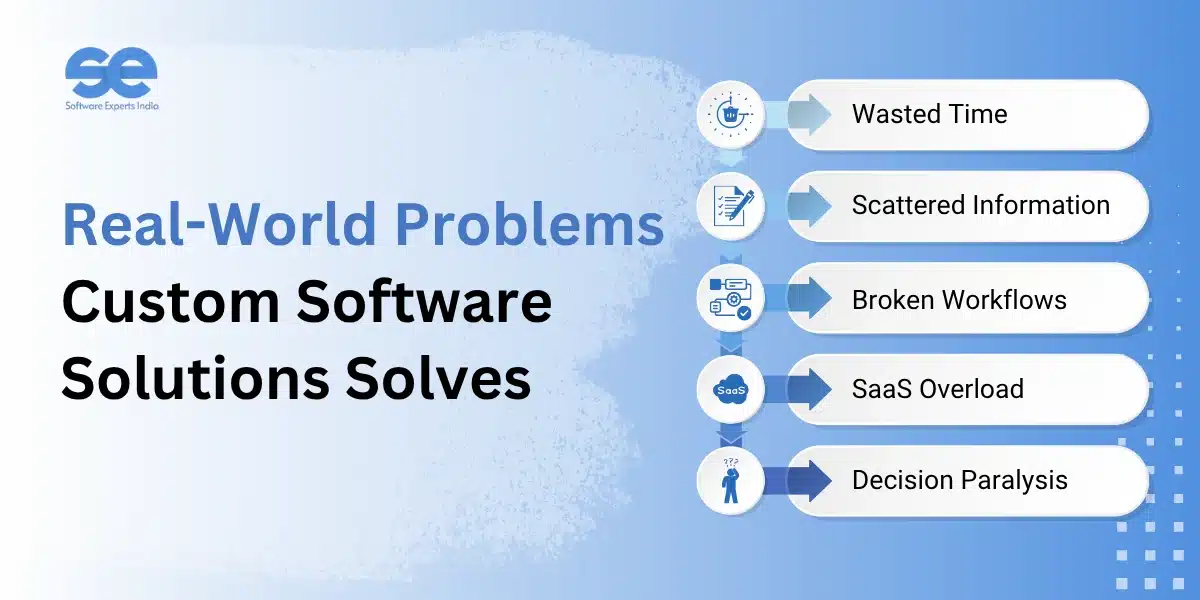
The Real-World Problems Custom Software Solutions Solves

Before we talk about features or ROI, let’s talk about what’s actually happening inside most growing businesses today: 

  • Wasted time: Teams are manually entering the same data into three different systems. 
  • Scattered information: Your sales team, support desk, and finance department each use separate tools, and none of them sync smoothly. 
  • Broken workflows: A customer makes a request, but it takes three follow-ups and five systems just to process it. 
  • SaaS overload: You’re paying for tools you barely use, while still relying on spreadsheets to fill the gaps. 
  • Decision paralysis: You can’t get a real-time view of your operations because your data is fragmented or outdated.

These aren’t just “software annoyances.” They affect how fast you serve your customers, how informed your decisions are, and how much your team can actually get done in a day. 

And the tough truth is that off-the-shelf (pre-made products or software) tools can’t solve these problems, because they weren’t built for your business. 

They were built for the average business. 

But if you think you’re not an average business then your systems shouldn’t be either. 

That’s where custom software solutions show their real value. It makes your daily work faster, cleaner, and far more aligned with how your business really runs.

Custom Software vs Off-the-Shelf: What’s the Real Difference? 

You’ve heard it before: “Why build something when you can just buy it?” 

It’s a fair question. Off-the-shelf software is faster to get started. Generally, they are cheaper upfront and come with useful features. 

But the question is, are those useful features even essential or necessary? 

Feature  Off-the-Shelf Software  Custom Business Software 
Fit for Business  Generalized for many industries  Built specifically for your processes 
Scalability  Limited customization, hard to scale  Designed to grow with your business 
Integration  Tricky to connect  Built to sync with your existing systems 
Data Control  Shared environments, limited access  Full ownership, secure, compliant 
Costs Over Time  Lower upfront, higher long-term  Higher upfront, lower ongoing maintenance 
Support  One-size-fits-all support  Dedicated or in-house support 
Innovation Speed  You wait for new features  You decide what gets built, and when 

 Here’s the reality: 

Off-the-shelf or generic software can work if your processes are simple, or you’re just starting out. 

But once your business starts to grow, and you’ve built ways of working that actually make you different from competitors… 

These generic tools start to slow you down. 

Investing in software solutions that are customized to your needs becomes a core part of your operations whether it’s automating what should be automated, surfacing real-time insights, and letting your team work the way they work best.

How Custom Software Improves Operational Efficiency? 

You are a decision maker, so tell me what “Efficiency” is.
Is it just about speed or does it have anything to do with clarity as well? 

Most businesses don’t struggle because people are lazy but because people are bogged down by broken systems. They are: 

  • Repeating the same tasks across multiple platforms 
  • Chasing down updates across teams 
  • Manually pulling reports instead of getting real-time dashboards 
  • Relying on “tribal knowledge” because the system doesn’t guide the process
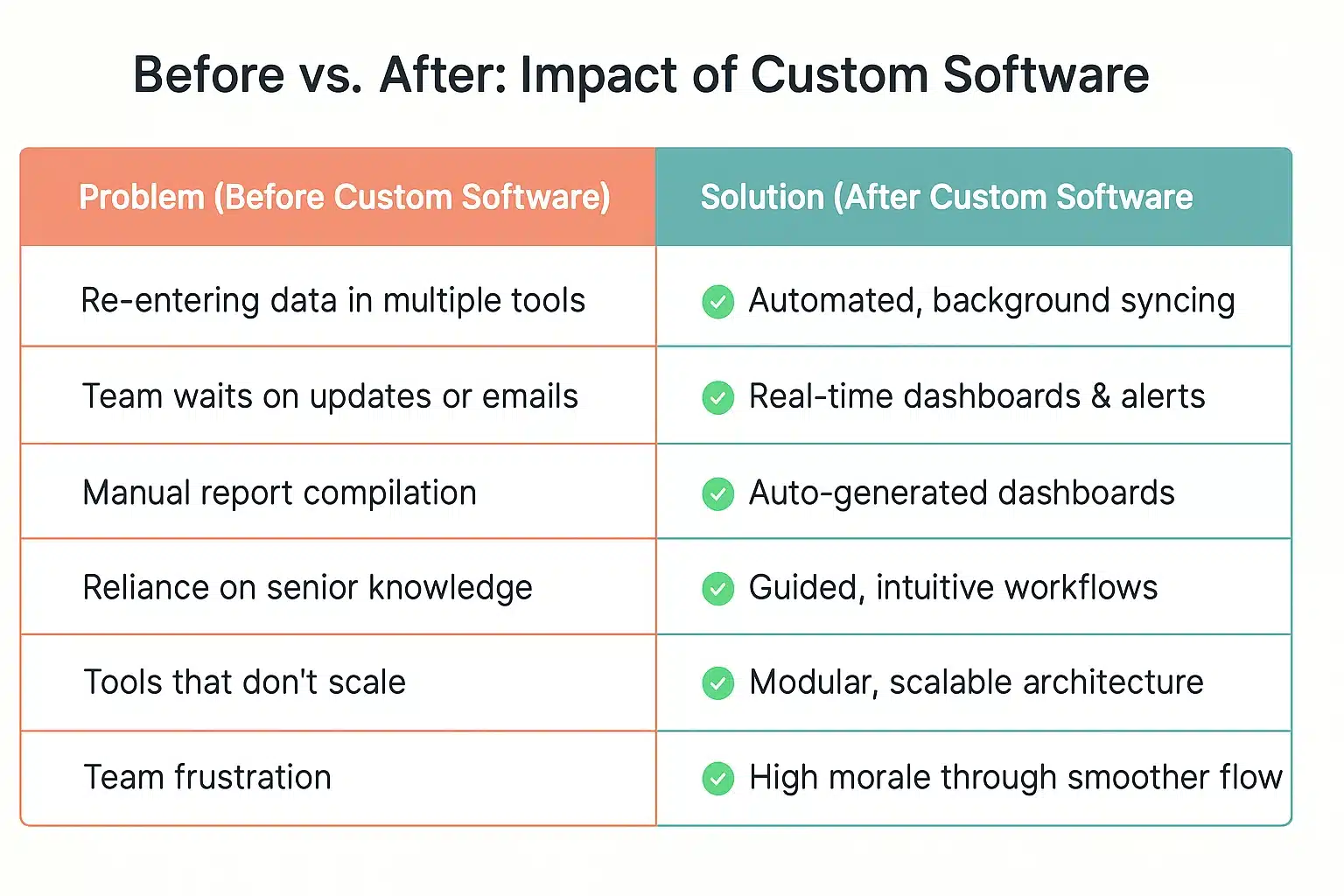
Before vs. After effects of Custom Software
Here’s how Custom software for businesses changes that dynamic:

It automates the repetitive. 

Tasks like data entry, invoice generation, follow-ups, inventory syncsthese can all run in the background. That frees up your team to focus on what actually moves the needle. 

It gives you one source of truth. 

No more cross-checking spreadsheets with dashboards. Custom business software solutions unify your data across departments, so decision-making is faster, cleaner, and grounded in real-time reality. 

It fits how your team already works. 

Custom business software workflows reflect your process. This means less training time, higher adoption, and less frustration across departments. 

It scales with your operations. 

As you grow, your software grows with you, and it should grow. New modules, added users, or features to handle more orders, customers, or internal tasks scale with you if you are using custom business software solutions. 

Most importantly, it boosts morale. 

Because when work flows smoothly, people stop feeling like they’re fighting the system just to do their jobs. 

How Custom Software Enhance Data Security and Compliance? 

In 2025, data is currency and liability as well. 

Whether you’re in finance, healthcare, eCommerce, or logistics, your business runs on sensitive data. It has customer records, payment info, employee data, operational metrics, and maybe even IP addresses. 

And if that data lives across a dozen disconnected systems, you’ve got more than just an integration issue. 

You’ve got a risk problem. 

Off-the-shelf platforms come with a catch: 

  • Shared hosting environments 
  • Standard security protocols (good, but not tailored) 
  • Limited visibility into how your data is stored, accessed, or moved 
  • Updates and patches that aren’t in your control 

With custom business software solutions, you control the rules: 

  • Host your data wherever you want (cloud, hybrid, or on-prem) 
  • Implement security protocols designed for your industry (e.g., HIPAA, GDPR, ISO) 
  • Set up granular permissions like who can access what, and when 
  • Audit logs, encryption, and real-time alerts built around your risk profile 

And when regulations evolve (as they always do), your software can evolve too.
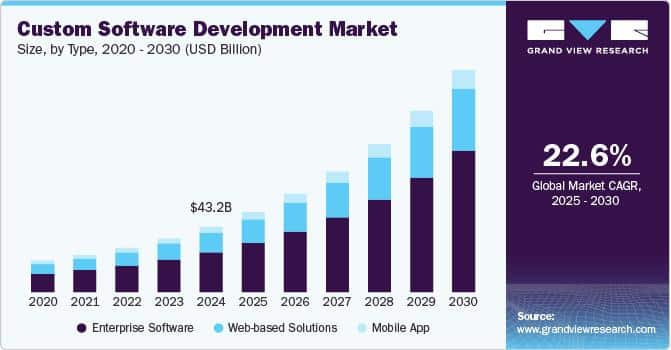
And when regulations evolve (as they always do), your software can evolve too 

Custom Software Development Market
|Source: grandviewresearch.com|

The Real ROI of Custom Software Solutions

Let’s move past the hype. What does custom software actually return in business value? 

According to a Forrester Total Economic Impact™ report (used in case studies for platforms like Microsoft, ServiceNow, and Salesforce), organizations investing in tailored software or platforms see: 

  • ROI between 200% and 400% over three years 
  • Payback periods as short as 6–12 months 
  • Productivity gains of up to 30% across operations 
  • 20–50% reduction in manual tasks and IT maintenance costs 

Now let’s make that practical. Here’s where the return comes from: 

  1. You Reclaim Hundreds of Productive Hours

Let’s say your team spends 2 hours a day managing spreadsheets, copy-pasting between tools, or chasing status updates. 

Across a team of 10, that’s: 

  • 20 hours/day 
  • 400 hours/month 
  • 4,800 hours/year 

Even at a modest $20/hour, that’s $96,000/year wasted labor. 

Custom software automates these repetitive workflows. That’s real money back in your business.

  1. You Eliminate “SaaS Stack Bloat”

Most mid-sized companies use 20 to 50+ tools across departments. A SaaS subscription here, another there… it adds up. 

A 2024 report by Productiv found that 40% of SaaS licenses are still going unused 

Custom software consolidates what you need into a single, efficient system. It means no more paying for things you don’t use. 

  1. Better Data = Smarter & Faster Decisions

When your data is spread across 6 platforms, you’re not agile. Custom-built software platforms centralize your data so you can: 

  • See KPIs in real time 
  • Forecast with confidence 
  • Spot risks before they hit revenue 
  1. You Avoid Expensive Mistakes and Fines

Security and compliance failures cost businesses dearly. 

IBM’s 2024 Cost of a Data Breach report showed that the average breach costs $4.9M, with 83% of organizations experiencing more than one. 

Custom software can be built with your exact compliance needs in mind, from GDPR to HIPAA. It reduces risk at the core system level.

4 Benefits of Custom Software Development for Businesses in 2025 

Every business has access to the same SaaS tools now. Your competitor uses the same CRM, the same email platform, and the same analytics dashboard. These platforms force you into someone else’s process, someone else’s limitations.  

Custom software solutions are how you break that symmetry. It’s how you build internal advantages that competitors can’t copy. 

Here’s how custom software development benefits you: 

  1. It makes your strengths scalable

Your competitive advantage might be operational speed, customer service, pricing strategy, or even how you handle logistics. Custom software takes that strength and scales it. 

Instead of adapting your processes to software, you build software that enhances what already works for you. 

That means less compromise and fewer workarounds 

When everyone else is stuck adjusting their business to fit the limits of their tools, you’re free to double down on what makes you better. 

  1. You execute faster than the market moves

The difference between being first and being late is a few weeks or maybe less. 

If you choose the right software development model, it gives you the flexibility to launch new products, add new workflows, or pivot strategy without asking a vendor when it’s on their roadmap.  

In a market where everything changes fast, custom software gives you the speed to leverage. 

  1. You control the experience

Custom software lets you deliver an experience that’s uniquely yours: 

  • Your onboarding flow 
  • Your data and dashboard views 
  • Your communication triggers 
  • Your logic for pricing, support, loyalty, or delivery 
  1. You reduce dependency and risk

Every off-the-shelf tool is a dependency. 

If pricing goes up, features get killed, or the vendor gets acquired, your business takes the hit. 

With custom software solutions for business growth, you own the core systems you rely on. You’re not building a home on rented land.
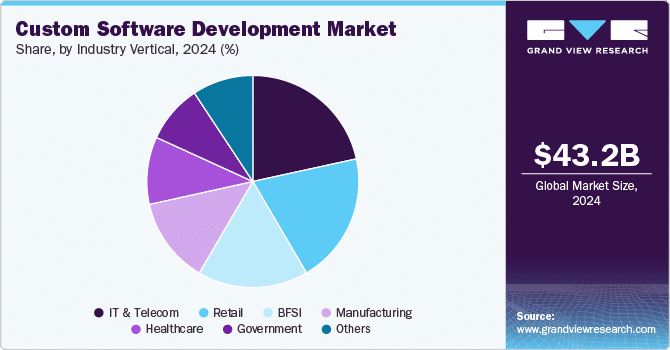
Custom Software Development Market share
|Source: grandviewresearch.com|

What Happens When You Don’t Invest in Custom Business Software Solutions? 

Sometimes the clearest argument for action is understanding what happens if you don’t take it. Businesses that stick with generic tools often don’t fail dramatically. 

They fade quietly and slowly under the weight of inefficiency, missed opportunities, and growing complexity. 

Let’s break it down. 

  1. You outgrow your tools before you outgrow your competition

Most businesses start with off-the-shelf platforms for good reasons: affordability, speed, and simplicity. 

But as you grow, the cracks appear: 

  • Workarounds multiply 
  • Departments create their own systems and hacks 
  • You end up hiring people just to manage software that was supposed to “save time” 

By the time you realize you’ve outgrown your stack, your competition might already be running ahead. 

  1. You spend more than you think on “cheap” tools

Here’s the hidden cost of sticking with off-the-shelf software: 

  • Multiple tools mean multiple subscriptions 
  • Integration costs pile up 
  • Manual processes create payroll drag 

Ironically, the longer you delay investing in software solutions that are customized, the more you overspend trying to hold together your existing setup. 

  1. Your innovation gets throttled

Want to launch a new service? Tweak your business model? Enter a new market? 

Good luck doing that if your current tools can’t adapt or if changing a single workflow requires months of vendor negotiation. 

Custom software gives you freedom and generic software makes you dependent. In a fast-moving market, that’s dangerous for your business. 

  1. Your data becomes a liability instead of an asset

When you use 5+ disconnected tools: 

  • You can’t see the full customer journey 
  • Your reports are out of sync 
  • And worse, you risk non-compliance with data privacy laws 

Custom software solutions help you centralize, secure, and act on your data confidently. Without it, your business runs on guesses and patchwork visibility.

How a Fortune 500 Company Boosted Sales with Our Custom Software? 

One of our recent projects involved building a custom enterprise application for a Fortune 500 company struggling with fragmented systems and siloed customer data. 

We developed a unified platform that integrated sales and customer info, eliminated duplication, and gave the sales team real-time access to critical data. 

Our custom software delivered:  

  • Faster, more confident sales decisions 
  • Better customer experiences 
  • Clear growth in revenue and deal flow 

Final Thoughts 

In 2025, businesses no longer compete just on price, product, or marketing. 

They compete on systems. The businesses that win are the ones whose tools are built around their people, data, and future plans; not the other way around. 

Here’s what we’ve found in this article: 

  • Off-the-shelf tools have limits  
  • Custom software reduces waste and improves how your entire business functions 
  • The ROI is time saved, revenue unlocked, and risks avoided 
  • Most importantly, it aligns with you 

So, if you’re still treating software like a fixed cost… it’s time to see it as a competitive asset. 

Custom business software solutions are how modern businesses future-proof their operations and build systems they can grow into. 

 What is your next step? 

  • If you’re outgrowing your current stack… 
  • If you’re spending more on duct-taped tools than you realize… 
  • If your team is wasting time on work that should be automated… 

Then now’s the time to explore custom solutions designed for your industry and business, not someone else’s idea of one. 

Let’s build systems that actually move the business forward. 

FAQs 

Is custom business software worth the investment in 2025? 

Yes, especially if you’re scaling or facing operational inefficiencies. Custom software can automate manual tasks, centralize data, and eliminate tool sprawl. According to trusted research, they can deliver a ROI of 200–400% within a few years. 

How is custom software different from off-the-shelf software? 

Off-the-shelf software is built for the masses. They are simply one-size-fits-all. Custom software is built around your exact processes, team structure, and growth goals. It offers better fit, flexibility, and long-term value. 

How long does it take to develop custom business software? 

Timelines vary based on scope, but most MVPs (minimum viable products) take 3–6 months. More complex solutions may take 6–12 months. The key is starting with a focused core, then scaling features over time. 

What’s the cost of building custom business software in 2025? 

Depending on complexity, costs range from: 

  • $30K–$80K for basic apps or internal tools 
  • $80K–$200K for robust multi-feature platforms 
  • $200K+ for enterprise-grade systems with integrations, security, and AI 

Contact us and share your requirements, based on that we will tell you, our cost.
 

Bespoke Software to Revolutionize Your Business

Off-the-shelf software not aligning with your business processes and is it not being able to integrate with existing tools? Is it the lack of customization options with limited scalability making it tough for your business operations to adopt to new strategies? Ignoring the benefits of custom software could lead to your business trailing others in efficiency and innovation. The problems are not just limited to whatever that has been mentioned above, it can be more.  

The standout point of bespoke software development is that it has gained enough popularity in recent years because of its unique features and functionality and unlike off-the-shelf software it does not have limitations due to its fixed features. The list goes on as to why having bespoke software is essential. 

The Shift from Off-the-Shelf to Bespoke Software 

Off-the-shelf software once reigned supreme like a basic smartphone, good for the essentials but lacking those apps and features you really wanted. As businesses evolved, they realized this software didn’t offer the customization, flexibility, or specific functionality they needed to keep up with their unique operations. 

This led to a shift towards bespoke software development, which is custom-built to meet the precise needs of a business. It offers tailored solutions, better scalability, and improved integration with existing systems. As a result, bespoke solutions are the preferred choice over generic alternatives. An example where this shift can be seen in the retail industry, where companies like Nike transitioned from using off-the-shelf software to adopting bespoke solutions.

Nike developed custom software to streamline its inventory management through personalized e-commerce features and integrate with their global supply chain more efficiently. This tailored approach allowed Nike to better manage its operations and were able to offer a more personalized shopping experience, ultimately making bespoke software the more effective solution than generic alternatives.

Also Read : What is the Prototyping Model in software engineering?

The Surge in Popularity of Tailored Software Solutions

1. Tap into the power of Personalization

Just like no two businesses are alike and their software needs will vary as well. With their unique workflows, challenges and goals, the needs are all different. Off-the-shelf solutions often miss the mark, but bespoke software is designed to cater to a company’s exact requirements. This level of personalization is driving businesses to invest in custom-built solutions.

2. Maximizing Flexibility and Agility

The business world never stops spinning and neither should your software. While off-the-shelf solutions may get stuck in the past, bespoke software is your agile partner, ready to adapt to market changes, customer demands, or shifting regulations. Need a tweak? Custom software evolves as fast as your business does, no waiting around for a vendor update. 

Take Netflix as an example their bespoke software evolves just as quickly as the entertainment landscape. They use custom-built systems to rapidly respond to user preferences, adjust content recommendations, and stay ahead of competitors.  

3. Easy Integration with Existing Systems

Forget the tech headaches! Bespoke software development ensures your systems play nice together, syncing data effortlessly without causing disruption. Off-the-shelf software might leave you with a fragmented mess whereas the custom solutions are all about smooth integration and a unified experience. 

Spotify’s custom software integrates all its backend systems—user data, music libraries, playlists, and recommendations, so that each part of their service works together seamlessly, delivering a smooth user experience. 

4. Better Control Over Security and Compliance

Regulations? No problem. Bespoke software development meets all the necessary compliance standards, whether it’s protecting financial data or safeguarding patient health records. Off-the-shelf solutions often fall short but custom software has you covered. 

Finance companies use custom software to ensure compliance with the strict standards of the GDPR and other data privacy laws, offering customers confidence that their sensitive data is being handled with care and within legal boundaries. 

Also Read : What is Business Application Development, why is it important?

5. Cost-Effectiveness in the Long Run

Off-the-shelf software often comes with a monthly price tag, whether you are using all its features or not. Bespoke software may cost more upfront, but it’s designed to focus only on what your business needs. 

Tesla uses bespoke software to manage everything from production lines to customer data, ensuring they are only paying for the functionality they actually use, avoiding the extra costs that come with off-the-shelf software’s excess features. 

6. Improved User Experience

Tailored software adapts to your team, not the other way around. With a user interface that’s built for their exact needs, the software becomes second nature, so you can skip the long onboarding sessions and dive straight into work. 

Slack enables teams to design their workspace and integrate tools that align with their specific roles, allowing quicker adoption and less time spent on training. 

7. Faster Time-to-Market for New Features

Together with bespoke software and agile development, change is easy and fast. The iterative process means you are not stuck with outdated features and can rapidly roll out new updates, adjustments, and fixes based on what your team or customers need right now. 

Amazon is known for using agile methodologies to enhance its marketplace and improve customer experience, adding features like faster checkout, personalized recommendations and delivery options based on continuous customer input. 

8. Technological Innovation

Why settle for outdated tools when bespoke software lets you ride the wave of emerging technologies? Custom solutions can so easily integrate the latest innovations, from AI to blockchain, allowing your business to capitalize on fresh opportunities and lead in your industry. 

IBM Watson uses bespoke AI-driven software to offer personalized recommendations to clients, helping businesses harness the power of machine learning for deeper insights and smarter decision-making. 

9. Transparency and Ownership

Vendor lock-in? Not with custom software. When you own the code, you own your future. Custom solutions let you avoid being stuck with a vendor’s limitations, offering you the flexibility and ownership to make changes as needed. 

Salesforce offers bespoke CRM solutions, giving clients full control to add custom features and integrations, eliminating vendor lock-in and offering unmatched flexibility for their growing business needs. 

Custom Software: Potential Setbacks 

  • Developing bespoke software requires a significant upfront investment in time and money. The design, development, and testing phases can be expensive, especially when compared to off-the-shelf solutions. 
  • Customization, testing, and iterations to meet specific business needs can delay the launch of the software.  
  • Once your software is up and running, you are dependent on your development team—not getting rid of them easily anytime soon! They are your go-to for updates, support, and fixing bugs. 
  • Ongoing maintenance is required to keep the software running smoothly and any updates or new features that have to be developed by the original team or a new team can be costly and time-consuming. 

To sum up

Bespoke software is the ideal way to cater to a business’s specific requirements, for those who are looking for enhancing efficiency and adaptability. Having a personalized approach that improves workflows, drives growth and ensures a seamless fit with their unique needs. Custom-built solutions offer the flexibility to scale, adapt to changing market demands. Check out the Software Experts for all the custom solutions to optimize your operations and accelerate growth. 


What is the Prototyping Model in software engineering?

Why spend all your time and resources building a final product from scratch when you can start with a working model that captures the basic essence of your software? After all, start with a software prototype that allows you to test, tweak, and refine before committing to the full-scale version. It gives a clear sense of how the final product will come together that lets you save time, money, and potential headaches down the line. 

Perfect for projects where the goal is a bit blurry and is still evolving, this model helps keep things on track. Thus, the prototype model in software engineering is about constant refinement. Agile gives prototyping the flexibility it needs, making it even better by allowing it to evolve with real-world feedback. 

The Prototype Model: Copy, Paste, and Improve! 

This system takes a shortcut by cloning an existing object (the prototype) and tweaking it to create new ones. It’s like making a copy of something but giving it a new color or shape which needs less work, yet you can expect the same result. 

When can you use it 

  • When Time Is of the EssenceThe software engineering prototype model helps you cut through the design chaos when time is tight and also when you need quick delivery. That’s when cloning an existing object is much faster than building something from scratch. It saves time by skipping over the initial complex design phase. 
  • Similar Objects with Minor Variations: Working with a set of objects that are largely similar but require small tweaks or variations, cloning is the perfect solution. 
  • Dealing with Complex Object Creation: If the creation of a new object requires complex logic or time-consuming setup, cloning a pre-existing prototype can save valuable development time and resources. 
  • Experimenting with Different Variations: If you want to try out several variations of an object (e.g., different UI layouts or configurations), software prototyping allows for rapid experimentation. This allows for making quick adjustments to each clone, testing it, and seeing which version works best. 
  • When Resource Management Is Crucial: Working with a lean budget but aiming for a king-sized result? clone objects rather than creating them from the ground up is often more cost-effective. You save time, effort, and even computing resources when cloning prototypes. 
  • When Maintaining Consistency Across Objects: If your project requires uniformity, such as when creating a series of objects that need to maintain the same structure or properties, cloning ensures consistency. Every cloned object starts with the same foundation, reducing errors or deviations. 

Also Read : Fueling Business Transformation with Adaptive Software Development

  • When You Need to Quickly Test and Iterate: In the early stages of development when you need to quickly build different versions to test, software prototyping lets you do so rapidly. You can iterate and refine without having to reinvent everything each time. 
  • When Developing Software with a Modular Approach: For software that has modular components, cloning and modifying prototypes can help you quickly create modules with similar characteristics. It allows for faster prototyping and reusability of components across the system. 
  • When You Need to Support Legacy Systems: The prototype model in software engineering is your solution. Merging the best of both worlds with the new upgrades and legacy systems, working side by side because of cloning prototypes can be more efficient than starting from scratch. It helps maintain compatibility while introducing necessary improvements. 
  • When The Requirements Are Unclear: Unsure about the exact requirements or features needed in the final product? Begin with a prototype and cloning it as you receive new insights or updates can help refine the product incrementally. It lets you adjust based on real-world feedback without overcommitting to a design. 

Latest Features and Trends in Prototyping 

Feature/ Trend  Description 
Low-Code/No-Code Tools  Platforms like Figma, Webflow, and Bubble allow non-technical teams to create prototypes without deep development knowledge, democratizing prototyping. 
AI-Powered Prototyping  AI tools generate designs and prototypes based on minimal input, predicting user needs and improving early-stage development, especially in UX/UI design. 
Interactive Prototyping  Tools like Axure, InVision, and Marvel offer prototypes that simulate real-world experiences, including animations, dynamic content, and logic for testing. 
Integration with Agile Development  Prototyping is now integrated with Agile methodologies, enabling rapid iteration in short sprints, which promotes flexibility, faster delivery, and continuous improvement. 
User-Centered Prototyping  Prototypes are increasingly focused on aligning with real user needs and behaviors, continuously incorporating user feedback to create products users truly want. 


Cloning Done Right 

  • Server setups can seem to be tedious, but software prototyping can streamline the process. Suppose to design a new app interface, instead of starting from zero, why not clone an existing layout and tweak the buttons, colors, and fonts? It’s like changing the wallpaper on your phone that has a fresh look with same functionality! 
  • With a dash of cloning designing a website by using the template and tweaking the content, you can create a whole batch of identical but unique websites. A dash of cloning, a sprinkle of editing that can be done in no time. 
  • The prototype model is helpful even for product customization when just tweaking and cloning of the basic design can lead to many possibilities for the same product. There is no need to design each item from the very beginning.  
  • Clone the core module and adjust it to fit the new project during software development. This model is useful when developing software with similar modules (like user authentication or payment gateways). 
  • Designing different versions of an app interface? Instead of starting from a blank canvas every time, clone an existing layout and adjust things like buttons or colors. This gives a familiar look but gives a personalized touch. 

Also Read : 12 Best System Development Methodology

Best Practices for Successful Prototyping 

The prototype model in software engineering isn’t about quickly putting together a rough idea and hoping it works but it is about developing a focused, user-centered model that gradually transforms into the final product through continuous iterations.  

Here are some best practices to ensure your prototype is effective and serves its purpose: 

Involve Users Early and Often 

Using the prototype model in SDLC means involving your users from day one and keeping them engaged. Feedback is essential in this case and not just wait until the final product is done to find out if it’s what users actually want. The earlier you catch bugs, the fewer you will have at launch! 

Keep Iterations Focused and Manageable 

Since prototyping is an evolving process, but that doesn’t mean that one should try to build the entire project at once. Focus on small, manageable changes each time, just like refactoring code—no need to overhaul everything in one go. Keep it lean and mean! 

Need Help Building a Prototype for Your Software Idea?

We are here to help

Reach out to us

Align Prototypes with Real-World Expectations 

The software prototyping is a working model that should mimic what users will experience. So, design it with real-world usability in mind and not just for the look. The goal? No surprises when users interact with the final product—just smooth, seamless functionality. 

Manage Scope and Avoid Feature Creep 

Remember, more features don’t always mean better. Stick to the essentials. Eliminate the unnecessary part keeping just the core features that actually solve the problem.  

So, follow these best practices, and your prototype won’t just be a placeholder. It’ll be a key steppingstone to the final product that’s user-approved and ready for prime time! 

Wrapping it up, the Prototype Model is your safety net in the unpredictable world of software development. It lets you build, test, and refine before diving into the deep end. If you are looking to avoid missteps and streamline your process, Software Experts has your back with all the solutions to make your prototypes—and final products—shine! 

Also Read : Is the Software Development Cycle Still Relevant in 2024?

FAQs 

What is a Prototype model in software engineering? 

The Prototype model involves creating a basic version of software —test the basics, get feedback, and perfect it before the final show! 

What are the 4 types of Prototype model?  

Four types of Prototyping models are:  

  • Rapid Throwaway prototypes.  
  • Evolutionary prototype.  
  • Incremental prototype.  
  • Extreme prototype. 

What is prototype with example? 

It is like a rough draft of your software more like a “sneak peek” before the final version. Example: Instead of building a full website, you create a simple clickable model to test layout and user flow, tweaking it based on feedback before going all-in. Think of it like trying on shoes before buying them! 

Fueling Business Transformation with Adaptive Software Development


Change is the only constant and change is inevitable, especially in software development. It is through
Adaptive Software Development (ASD) that can help you stay ahead by embracing change and turning it into opportunity. Wondering what is adaptive software development is? It’s the key to thriving in a world where change is inevitable. This is a methodology that allows your software to adapt and evolve as technologies and user needs change. 

What if I told you that your software could be as fast as the changes happening around you, unlike traditional development methods that used to predict every possible outcome before starting! ASD welcomes change. Software can still stay updated because ASD is designed in a way to respond to evolving requirements, new technologies, and user feedback throughout the Software development cycle 

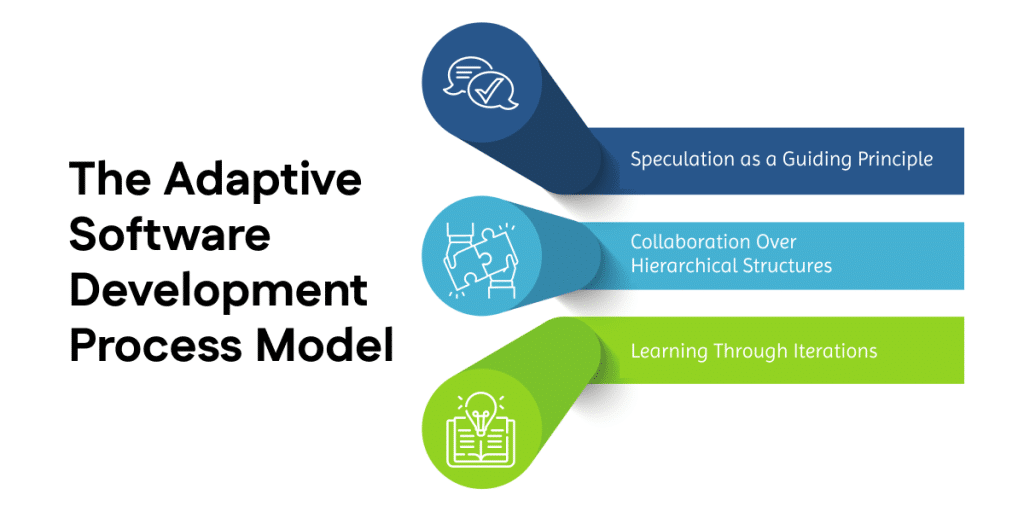
The Adaptive Software Development Process Model 

Adaptive Software Development Process Model 
Adaptive Software Development Process Model

To truly grasp what Adaptive Software Development (ASD) is all about, let’s understand its core principles: speculation, collaboration, and learning. These elements allow teams to navigate the unpredictable world of software development without tripping over their own feet.

  1. Speculation as a Guiding Principle

Forget about creating a detailed blueprint and hoping it holds up ASD embraces flexible thinking with informed guesses, not just static plans. Instead of rigid upfront planning, teams engage in speculation, making well-informed guesses about the road ahead and adjusting as new information rolls in. 

Example: 

Imagine a company building a smart home thermostat. At first, they speculate that consumers will want voice control, app integration, and energy savings. As the project progresses, user feedback shows a desire for more eco-friendly features and the team pivots to include solar panel integrations. Thanks to speculation, they stay flexible and adjust their product to meet evolving market trends. This flexibility is a major reason why ASD is favored in uncertain and fast-moving industries like tech startups. 

Also Read : 12 Best System Development Methodology

  1. Collaboration Over Hierarchical Structures

In ASD, the idea of the lone genius at the top of the pyramid is thrown out the window. Collaboration takes center stage, where developers from designers to designers work together, sharing ideas and expertise, making sure every aspect of the software hits the mark. 

Example: 

In a project to build a new e-commerce platform, the development team isn’t calling all the shots. Designers, UX specialists, and product managers come together to ensure that the website not only functions smoothly but also align with business goals. The result? A product that doesn’t just work but it delights.

A 2017 study by Scrum Alliance showed that teams working with collaborative methods in agile environments had 25% better customer satisfaction scores compared to those using traditional methods, highlighting the importance of cross-functional collaboration. 

  1. Learning Through Iterations

Instead of building a product in one big, risky leap, ASD breaks it down into manageable chunks—iterations—that allow teams to gather feedback, learn and then refine the product as they go. Every cycle is a chance to improve. Iterations equal to learning.  

Example: 

A mobile app development team releases the first version of the app, featuring core functions like user sign-in, profiles and push notifications. They gather feedback and users request a dark mode. The next iteration includes this feature, along with a bug fix for profile syncing. This continuous improvement cycle with adaptive software development ensures the app gets better and better, one user insight at a time. 

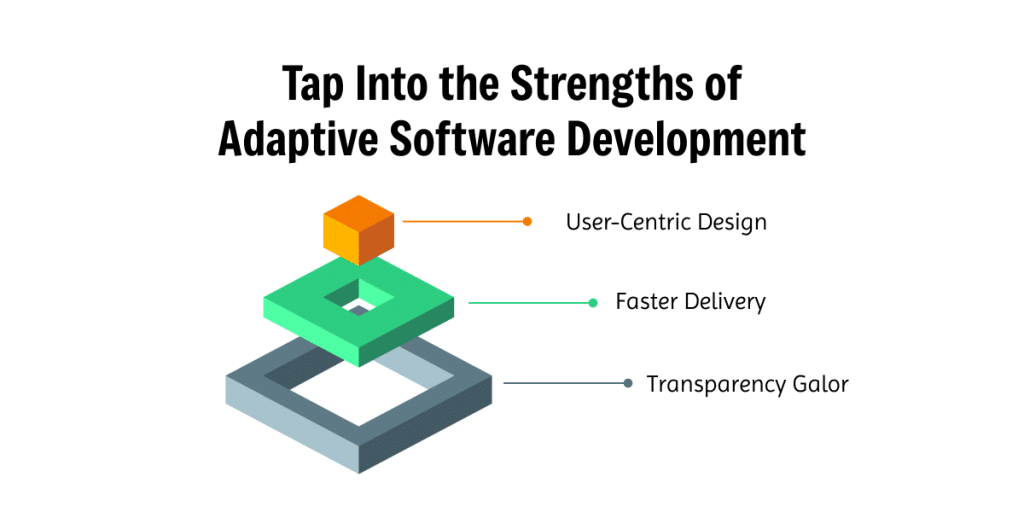
Tap Into the Strengths of Adaptive Software Development 

Strengths of Adaptive Software Development 
Strengths of Adaptive Software Development
  • User-Centric Design: ASD keeps the end user at the forefront, where creating products that not only meet the needs but surprises them with intuitive features. Software evolves based on direct user feedback.  

Suppose some users get lost in a sea of data while searching for something in dashboards, trying to find the right analytics. But the ASD design includes customizable dashboards so it’s possible to revamp the design and is easier for them to pick the metrics they want.  

  • Faster Delivery: With adaptive software development, you do not have to keep waiting around for months. This approach can deliver on time or even ahead of schedule, without sacrificing quality.  

A CRM software team can embrace ASD and with a swift approach, it can turn a standard deadline into an unexpected win. Their quick iteration and feedback-driven process deliver results faster than expected, without compromising the quality. 

  • Transparency Galore: Say goodbye to communication breakdowns! This feature-driven development fosters a level of transparency between developers and clients that makes everyone feel in the loop, every step of the way.  

Forget playing the guessing game where real-time tracking is right on your screen! With tools like Jira, both developers and clients are always in sync, spotting bugs and monitoring progress so that Issues get fixed faster than you can refresh your browser! 

Also Read : How to Choose the Right Software Development Model for Your Business

Implement Adaptive Software Development and Stay Ahead 

Curious about how to implement ASD? Don’t worry, you don’t need to spend weeks reading dry textbooks or memorizing complex theories. All it takes is a little shift in mindset and some straightforward actions. Let’s walk you through it, step by step! 

Align with the ASD Principles 

First thing’s first ASD isn’t the typical development method, so you and your team need to be on the same page. No need to read a manual, just start talking about it and get everyone on board. 

Here’s what you need to embrace to make it work: 

  • Build strong, collaborative teams: everyone is included! Open communication is key. 

For instance, in a cloud-based enterprise solution project, developers use Slack for daily stand-ups and Confluence to share documentation and track progress. Designers, testers, and engineers collaborate through Jira to keep everyone aligned and solve issues quickly, ensuring a seamless workflow across teams. 

  • Understand that change is necessary: Requirements will evolve and that is okay. In fact, that’s the entire point.
    Suppose, a blockchain platform that is built for simple transactions. But as feedback rolled in, the team quickly pivoted, adding Solidity and Ethereum to support smart contracts, keeping the platform ahead of the curve. 
  • Turn change into opportunity: Don’t resist the inevitable. See it as a chance to improve and innovate with adaptive service development. This can be seen in the case of Google Chrome when it updates its API, a web app team embraces the change by integrating the latest features, improving performance and enhancing security, rather than sticking to outdated methods. 

In short, success in ASD is all about curiosity and a willingness to think outside the box. So how do you make that happen? Easy: 

  • Train your team: Help everyone understand ASD principles, so they don’t feel like they have been thrown into a chaotic unknown. 
  • Manage change like a pro: Prepare your team for the unknown twist and turns and give them the tools to handle them. 
  • Get leadership on your side: Ensure that management is cheering for the ASD approach and backing it up with support

Innovation at Lightning Speed: How ASD Turns Ideas into Reality  

Whether it’s testing out new features or experimenting with cutting-edge tech, ASD doesn’t just allow you to keep up with the competition, it helps you get there first. By building software in manageable, iterative chunks, it lets you roll out innovations faster, without sweating over long timelines or waiting for the final product to be perfect. After all, who said the best ideas need to be slow to materialize? 

Example: Fintech Startup Gets Ahead with Blockchain Magic 

Take a fintech startup, for example. They adopt ASD to seamlessly integrate blockchain-based payments into their app. What started as a small, speculative feature quickly evolves with user feedback, pushing the team to iterate rapidly. By continuously adjusting their platform, they stay ahead of competitors, delivering innovative features while others are still planning meetings.  

Slack’s ‘Not Just Another Chat App’ Evolution 

So, what is adaptive software development in action? Take a look at Slack. Long back, Slack was just another messaging tool, but thanks to ASD, it quickly became the go-to platform for team collaboration. The team started with basic messaging features, but as feedback rolled in, they realized that the world didn’t just need another chat app, but there was a need for something smarter, faster, and more connected.

With ASD, Slack iterated quickly, integrating channels, file sharing, and integrations that had users hooked from day one. Result? A company that started as an internal communication tool evolved into a multi-billion-dollar business platform—just by continuously adapting to user feedback. 

Wrapping it up

In a world where change is the only constant, Adaptive Software Development (ASD) is your secret weapon to stay ahead of the curve. With its focus on flexibility, collaboration and continuous improvement, your software evolves in real-time and delivers faster, smarter results. At Software Experts India, the team doesn’t just adapt to change, they master it with ASD. They can make it happen—in adaptive style!

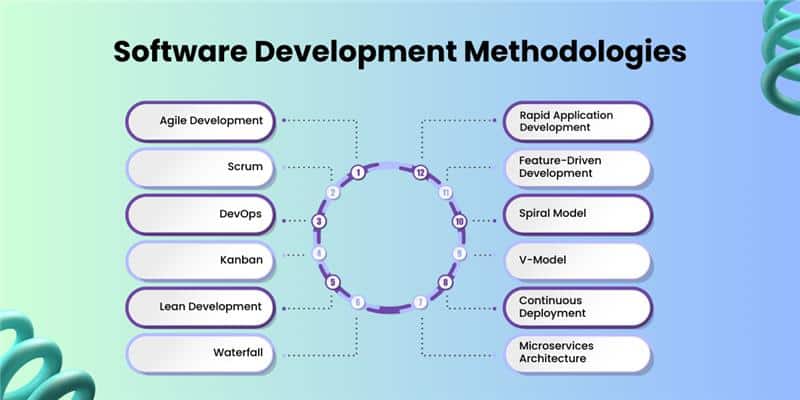
12 Best System Development Methodology

Three things one needs to look at while they are going to adopt any System Development Methodology, the first being how well can the teams’ sync, next is how well the project meets client expectations and how efficiently resources are utilized. Earlier System Methodology followed a structured approach but now it’s more flexible and adaptive.  

Some of the most widely used methodologies include Agile, Waterfall, Scrum, DevOps, and Lean, each with its unique processes and advantages. The key goal? To make sure that the development process is systematic, predictable and in sync with business objectives. Sounds simple, right?  These methodologies are the blueprint for how software is built, maintained and delivered.  

Importance of Selecting the Right System Development Methodology for Project Success 

Importance of Selecting the Right Methodology for Project Success

The choice of System Development Methodology has a profound impact on a project’s outcome.  

  • Certain methodologies are more suited for risk mitigation. The Spiral model emphasizes risk management at every phase while Agile frameworks like Scrum allow teams to pivot and make changes in response to new insights. 
  • The right methodology helps ensure that the software meets client expectations. In Agile, the stakeholders can see progress and provide feedback at the end of each sprint. 
  • Lean development methodology focuses on eliminating waste and is useful when resources like time, budget and personnel are limited. 
  • For quick updates or to adjust features based on customer feedback or changing requirements DevOps and Continuous Delivery provide the flexibility to do so. 

Also Read : How to Choose the Right Software Development Model for Your Business

Want to know the best System Development Methodology? It’s time to check them out! 

software development methodology

1. Agile Development 

It’s the future of System Development Methodology. Having a flexible approach, it focuses on delivering small, functional pieces of software in frequent cycles, called “sprints.” Agile emphasizes adapting to changes. 

              The latest trends in Agile development: 
  • Blending Agile with traditional Waterfall methods to create a hybrid approach. This “Agile-Waterfall hybrid” is useful for projects that require flexibility.  
  • As organizations scale Agile across multiple teams, frameworks like SAFe  is what that coordinates efforts and keep everything aligned at the enterprise level making even the largest projects manageable. 
  • Agile with AI and automation helping teams with tasks like automated testing, bug tracking, and sprint planning. 

2. Scrum 

This System Development Methodology is the framework that keeps you on track and it is a framework within the Agile methodology itself. Scrum is built on structured roles, ceremonies, and artifacts that keep teams aligned throughout the development process. 

Latest trends: 
  • AI tools integrated with Scrum to automate repetitive tasks such as sprint planning, progress tracking, and backlog grooming. 
  • Embraces more diverse skill sets within teams and blends cross-functional teams including developers, designers, testers, and business analysts. 
  • Teams can remain synchronized using SAFe (Scaled Agile Framework) or LeSS (Large Scale Scrum) that grants enterprises to apply Scrum principles across large and complex projects. 

Also Read : The Influence of AI and ML on Modern Enterprise Applications

3. DevOps  

DevOps is the glue that binds development and operations that aims to speed up the software delivery pipeline and issues are detected early with CI and CD automates the deployment process.  

Latest trends: 
  • DevSecOps is the latest evolution of DevOps where security checks and measures are automated. Security is a continuous process and yet an integral part of the entire development process. 
  • AIOps, where AI and ML are now being incorporated into DevOps. It uses data analytics to monitor, predict, and automate various IT operations processes. 
  • Turn infrastructure as code with GitOps which applies Git-based workflows to infrastructure management. Now you can manage your entire setup like a pull request—automated, seamless, and no more manual headaches. 

4. Kanban 

A visual workflow management method that helps teams optimize their task flow by organizing work into columns (e.g., “To Do,” “In Progress,” and “Done”), one task at a time.

Latest Trends: 
  • It’s not a standalone practice but now it is integrated with Agile. Being a hybrid approach, teams can manage both continuous flow and iterative and time-boxed sprints which makes it adaptive. 
  • Kanban merged with automation tools adds a layer of intelligence to the workflow. Integrating automation tools with Kanban boards to auto-assign tasks, track dependencies and even predict potential bottlenecks. 
  • Digital Kanban boards like Trello or Jira are becoming increasingly popular which makes it possible for distributed teams to collaborate in real-time. 

5. Lean Development 

Deliver maximum value with minimal resources with Lean development. It removes waste, reduces delays, and optimizes processes, thus eliminating anything that doesn’t add value to the end user! 

Latest Trends: 
  • Just-in-time production instead of over-producing emphasizes building only what’s needed at that moment, reducing excess work.  
  • Eliminating bottlenecks related to coding, testing, or deployment. Focusing on what truly matters and getting the right software into users’ hands. 

6. Waterfall 

It is a traditional, classic approach to software development where each phase of the project follows a strict sequence. It is perfect for projects with well-defined requirements and minimal changes. 

Latest Trends: 
  • Agile-Waterfall hybrid, this blend allows for clearer phases and deadlines. Also adapts to new insights and customer feedback throughout the project lifecycle. 
  • Waterfall 2.0 where incorporating feedback loops to adjust design or development phases mid-way through the process. 

7. Rapid Application Development 

It’s all about speed creating software quickly through iterative prototyping also emphasizes early testing to make improvements in real-time. 

Latest trends: 
  • One of the biggest trends in RAD is the integration of low-code and no-code platforms. Developers and even non-technical users can prototype applications.  
  • Automated prototyping is used that reduces manual effort and accelerates the development cycle. AppGyver is a low-code/no-code platform that automates the creation of mobile and web applications. 

8. Feature-Driven Development (FDD) 

This System Development Methodology breaks down the project into individual and well-defined features that are delivered in short cycles.  

Latest trends: 
  • AI-Driven feature prioritization to help predict which features need to be developed next and get to know when users frequently request a particular function or feature, AI flags this as a high-priority feature for development. 
  • Tools like Selenium and Jenkins can be integrated into the development pipeline to automatically run tests.  

9. Spiral Model 

It is a risk-driven development approach that is well-suited for large and complex projects. It combines the best elements of iterative development with a strong focus on risk management. 

Latest trends: 
  • It’s a perfect fit when it comes to risk management and adaptability as this System Development Methodology  often deals with unpredictable requirements and high-stakes risks. 
  • Combining the Spiral Model with Agile methodologies for frequent releases and continuous feedback. 
  • Advanced risk management in the Spiral Model is being enhanced by predictive analytics and AI tools.  

10. V-Model (Verification and Validation) 

Referred to as guardian of quality and is an extension of the traditional Waterfall methodology. Incorporates testing into every phase of development, this software meets the original requirements, and the verification checks ensure the software is being developed according to the design specifications. 

Latest trends: 
  • The key modern updates to the V-Model are the incorporation of automated testing tools. For instance, using Selenium, one of the most popular tools for automating web application testing. 
  • Modern practices allow for more parallel development and testing, thanks to automation and collaboration tools. 
  • Shift-Left Testing is a common trend in the V-Model which conducts tests earlier in the development lifecycle. 

11. Continuous Delivery/Continuous Deployment (CD/CI) 

These are the modern software development practices and the goal is that the software is always in a deployable state.  

Latest trends: 
  • For AI-driven test automation using Test.ai to leverage ML to intelligently execute and adapt test cases without human intervention. 
  • AI analyzes past testing data and predicts which features are likely to fail. You can stop wasting time and start finding bugs faster. 

12. Microservices Architecture 

Each microservice is focused on a specific business function and communicates with others via APIs. It is quite flexible as it involves breaking down large, monolithic applications into smaller, independent services.  

Latest trends: 
  • With AI, the system can forecast traffic spikes, allot resources in advance and even optimize workloads. Imagine your app scaling up or down on its own, optimizing workloads without human intervention.
  • AI-driven scaling of services where microservices can be resource-hungry, especially when demand fluctuates. AI-powered systems can predict traffic patterns and adjust microservice capacity in real-time. 

In conclusion

selecting the right System Development Methodology is crucial for project success. If you are looking for flexibility with Agile, precision with Waterfall, or scalability with DevOps, choosing the methodology that aligns with your project goals, team dynamics, and business needs can make all the difference.  

At Software Experts India, you will find a solid guide to the latest methodologies, helping you make informed decisions for your next project. Their expertise ensures that no matter the complexity or scale, they have the right approach for you.